

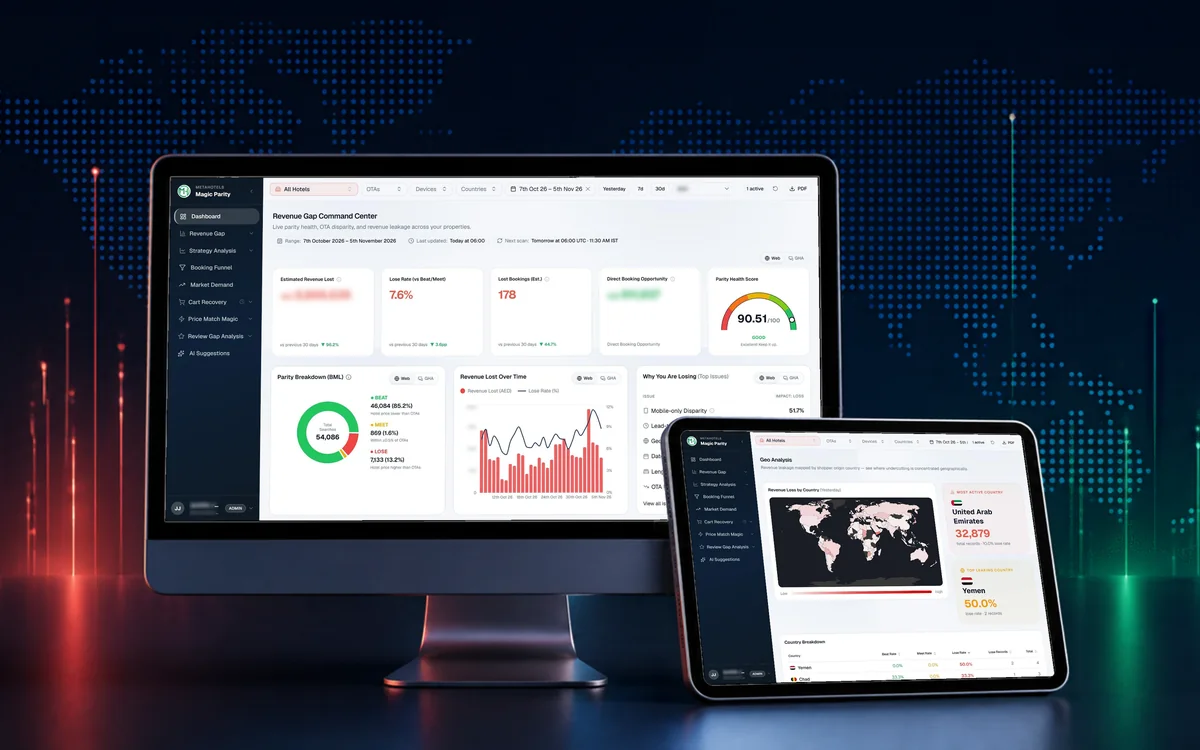
Meta Gap Analysis
A rate parity and revenue intelligence platform that ingests six daily data feeds and shows where 47+ hotels lose direct bookings to OTAs, with AI action plans and automated reports.
Read the case studyCompetitor rates for the next 90 nights, a suggested price with a reason for every night, and a website price that can now update itself. Built end to end for MetaHotels in about 15 weeks.
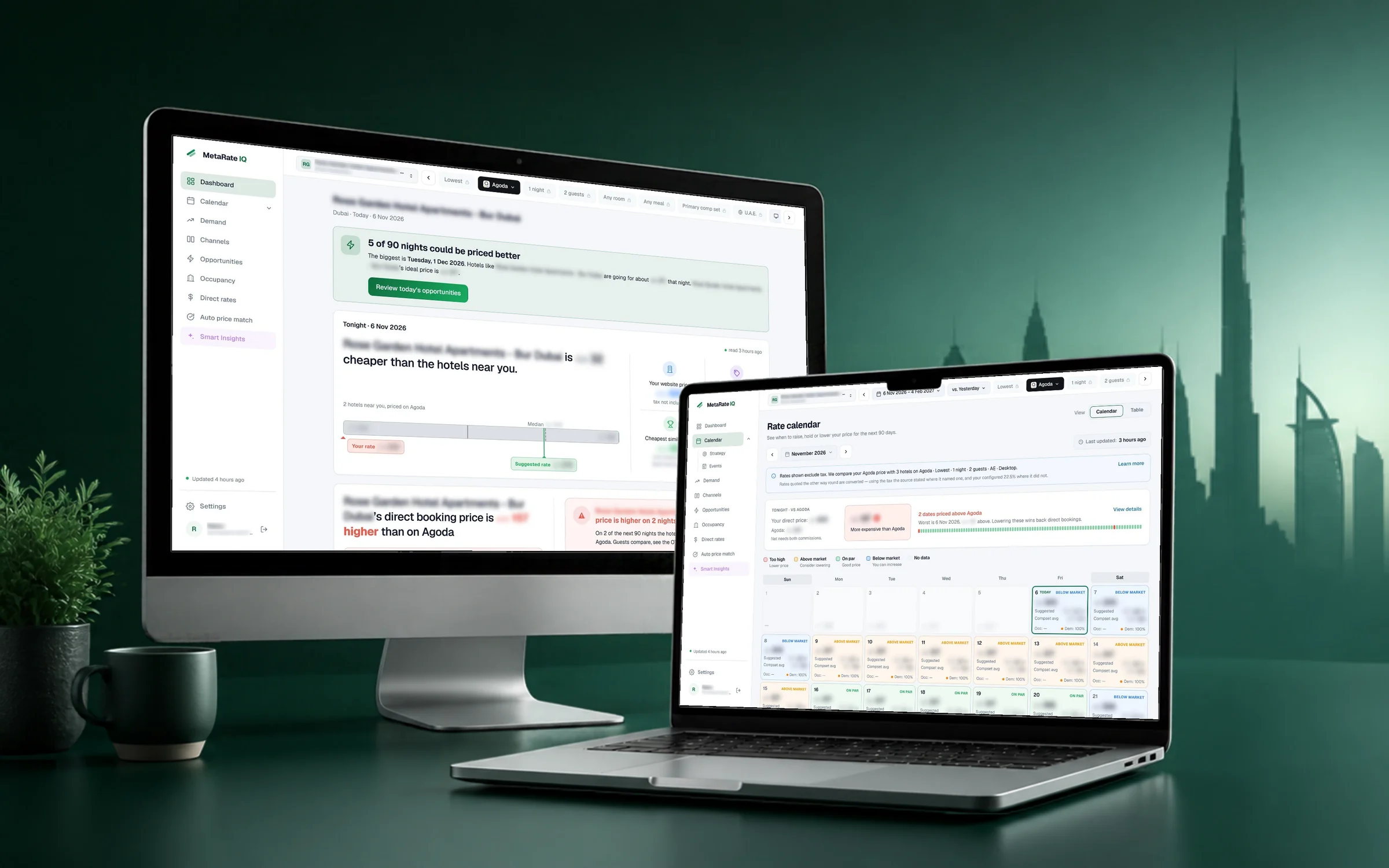
MetaRate IQ is a multi-tenant SaaS platform KloudBoy built for MetaHotels. It shows an independent hotel what its competitors are charging for the next 90 nights, tells it what to charge on its own website, and can now update that website price by itself.
It is three applications in one codebase: a hotelier app for owners and their teams, an internal admin console for the MetaHotels team, and background workers that collect and check rates every day. The first market is Dubai.
KloudBoy delivered it end to end: product specification, system architecture, database design, both apps, the data pipeline, the Mirai booking-engine integration, automated testing and production deployment.
Large hotel chains have revenue managers and enterprise pricing tools. Independent hotels set room rates on gut feel, last year’s numbers or a quick look at Booking.com, usually as one of ten other jobs. MetaHotels saw two costly gaps.
Hotels could not easily see where they stood against nearby competitors, night by night.
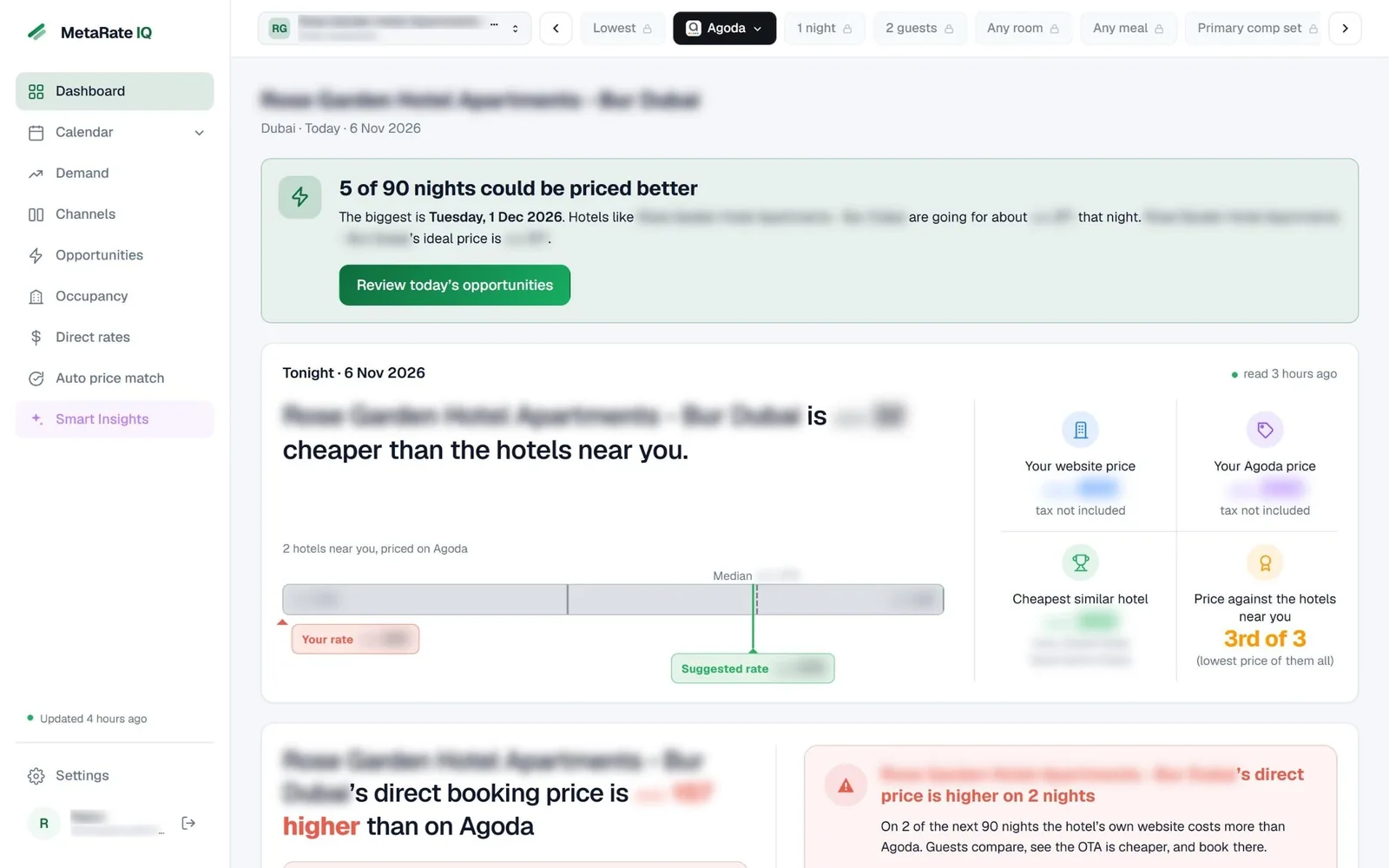
Direct bookings carry no OTA commission, yet many hotels priced their own website higher than Booking.com, effectively paying commission to send guests to the more expensive option.
Enterprise pricing tools and dedicated revenue managers are built for large chains, not for an owner or general manager with ten other jobs.
The brief: one number, one reason and one action per date, in under two minutes a day.
A hotelier app, an admin console and a data pipeline, shipped in stages that each added trust before automation.
A clean, focused workspace for hotel owners and their teams.
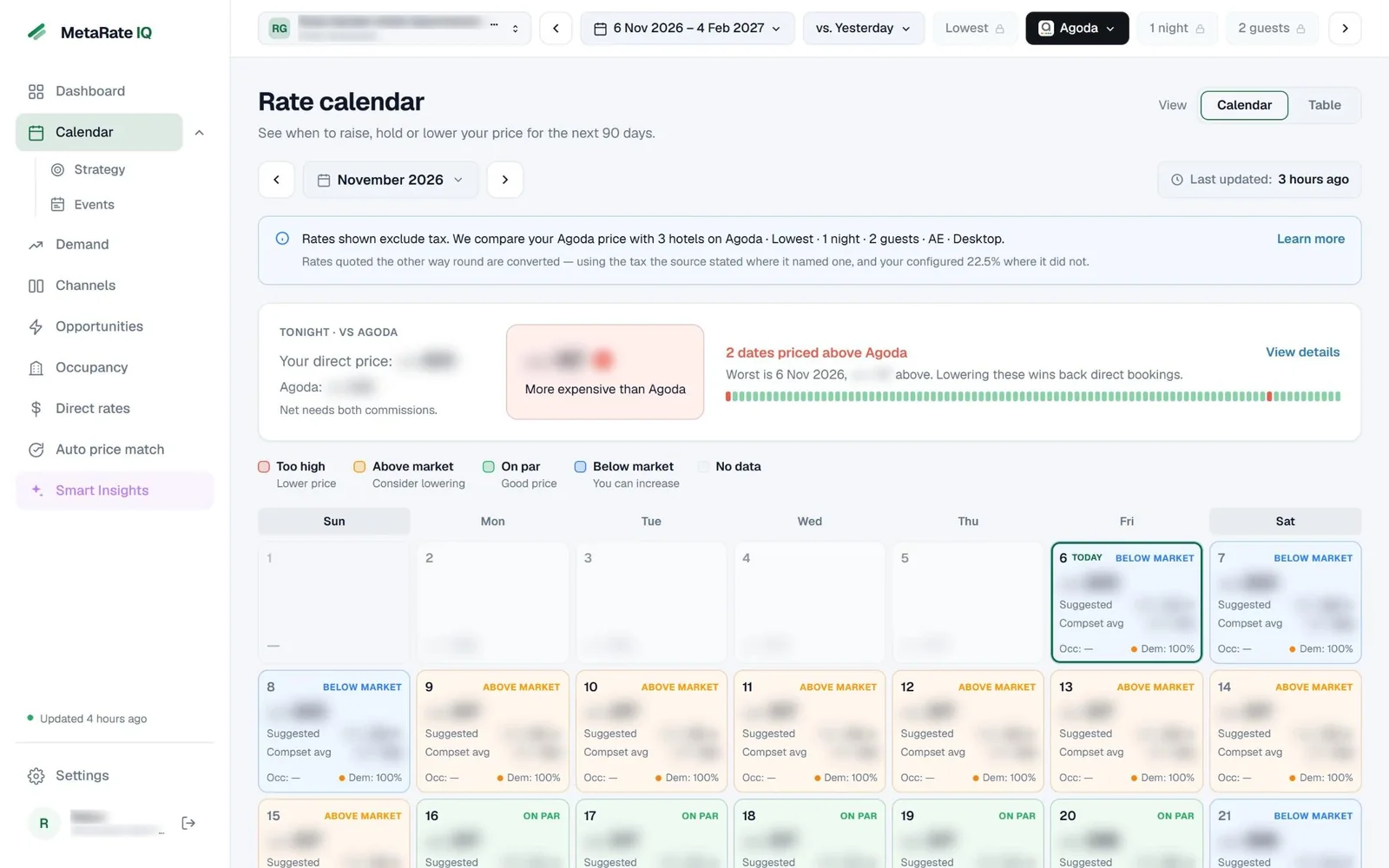
The hotel’s own rate against its competitors’ lowest, median and highest rate for every night, with a plain "2nd of 8" position, weekend shading and data freshness on every cell.
A transparent, rules-based engine suggests a rate for each night with a one-sentence reason ("3 of 6 competitors are sold out on Friday"). Hotels can accept, adjust or dismiss, and every decision is logged.
Minimum and maximum price per day of the week, seasonal strategies, rounding rules, direction (raise only or lower only) and a minimum change threshold, so owners are not flooded with tiny tweaks.
Compares the hotel’s own website against its OTA listings, shows the gap before and after commission, and flags every night where the website is the more expensive option.
A short, finishable list of the 3-5 dates that need attention, emailed at 8:00 local time and skipped when there is nothing to do.
City demand from Amadeus Demand360 data, local events, occupancy tracking, Booking.com search ranking and review scores over time, short-term rental comparison and a smart insights page.
Paste a Booking.com, Agoda or booking-engine link, and the platform recognises the hotel, fetches a live rate and asks the owner to confirm: a populated calendar in under 15 minutes.
Admin, Editor and Viewer roles per hotel, two-factor sign-in, invitations and a full activity history.
The headline feature, built in three stages, each adding trust before automation.
Sends a saved rate straight to the hotel’s Mirai booking engine, with a preview, a confirmation and a read-back that checks Mirai actually stored the price.
Automatic price updates, switched on by the platform and opted into by the hotel. Live in production from 1 November 2026.
Whenever the hotel’s website is priced above its own Booking.com (or other OTA) price, it lowers the website price to a margin the hotel chooses, always within the hotel’s own minimum and maximum and skipping blackout dates.
Each automatic change is read back from the booking engine and listed night by night, so the hotel can always see what changed and why. It never touches OTAs or channel managers.
A separate internal workspace for the MetaHotels team to run the platform.
Hotel groups, users, cities, channels, room categories and plan limits, plus a shared property registry with merge tools to keep hotel records clean.
Watch every data-collection run, retry a single fetch and open the original page behind any price, so "why did we show this rate?" is answered in minutes.
Parse-health monitoring and a quarantine for suspicious prices, Amadeus demand workbook uploads, event management and test emails. Every admin action is recorded in an audit log.
Background workers that collect and check rates every day.
Reads Booking.com, Agoda, Google Hotels and hotels’ own Mirai booking engines through swappable providers, with Firecrawl, Apify and an in-house fetch layer.
The next 14 days refresh daily and later dates weekly, keeping data costs low without losing what matters.
A hotel that is one customer’s property and another’s competitor is fetched once and stored once. Each new hotel in a city makes the platform cheaper to run, and new customers get price history from day one.
Prices that jump implausibly are held back for review instead of displayed: a wrong price is treated as worse than a missing one. Every raw page is archived, so any number can be traced back to its source.
Competitors can share public rate data, but one hotel’s occupancy, suggestions or settings are never visible to another. This is enforced in the database with PostgreSQL row-level security and two separate connection pools, and checked automatically before every release.
Rates with and without VAT and city taxes differ by 12-28%, more than most pricing decisions. Every price stores its tax basis, and the platform refuses to mix bases rather than guess.
Prices are shown before and after channel commission wherever a decision is made, so the hotel sees what it actually keeps.
A single Next.js application serves the hotelier app, admin console and API on separate domains, routed by hostname: simple to deploy, cleanly separated in use.
Errors and parsing failures report to Sentry, product usage is measured with PostHog, and a pilot-readiness report tracks data freshness and adoption goals.
Screens from the live MetaRate IQ app. Hotel names, people and every rate are blurred to protect the client's data.
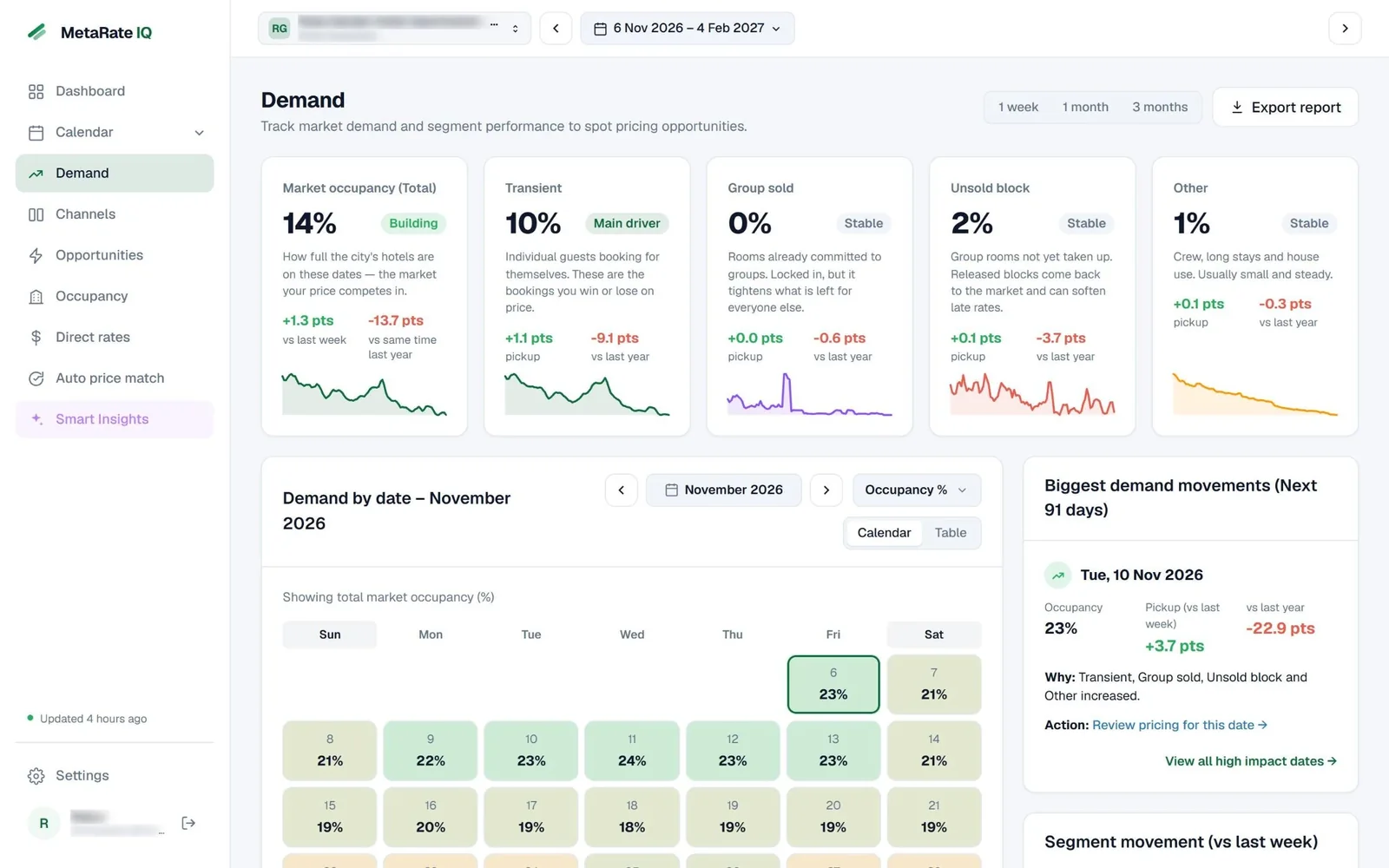
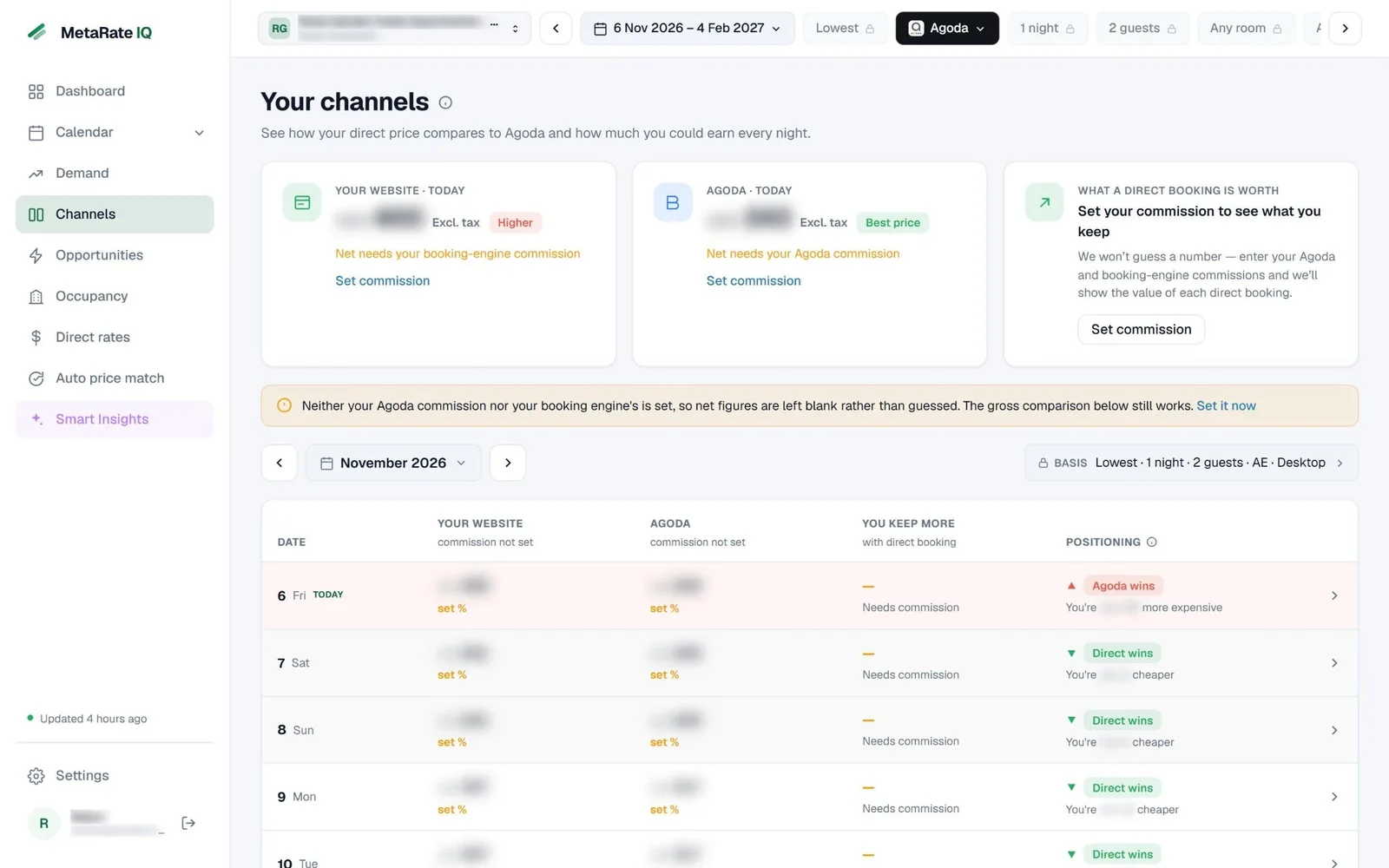
KloudBoy delivered MetaRate IQ end to end for MetaHotels: product specification, system architecture, database design, the hotelier app, the admin console, the data pipeline, the Mirai booking-engine integration, automated testing and production deployment.
The result gives independent hotels enterprise-grade pricing tools: they see their competitors’ rates for the next 90 nights, get a clear suggested price with a reason, and can let the platform keep their own website cheaper than Booking.com, safely and within limits they set.
A rate parity and revenue intelligence platform that ingests six daily data feeds and shows where 47+ hotels lose direct bookings to OTAs, with AI action plans and automated reports.
Read the case studyTell us what your platform needs to do - data, integrations, automation. An engineer, not a salesperson, will reply.